
AOLITE PU47 Mobile Energy Storage Power Supply — An Industrial-Grade “Power Bank” That Solves the Off-Grid Charging Challenge for Construction Machinery
When the charging station cannot move to the machine, the machine has to go to the charging station—but at what cost?
As the wave of electrification sweeps through construction machinery worldwide, a seemingly basic problem is becoming a core bottleneck restricting efficiency: the contradiction between fixed charging infrastructure and the mobility of job sites. Typical scenarios such as ports, construction sites, farms and municipal operations are often located in areas with weak or even no grid coverage. Driving entire machines back to fixed charging stations is not only time-consuming and labor-intensive, but also directly devours valuable productive working time.
This is the context in which mobile energy storage power supplies have emerged. From Volvo CE‘s PU40 mobile power unit to LiuGong’s mobile power vehicle developed for heavy-duty mining equipment, leading global construction machinery manufacturers are racing to establish a presence in this segment. Market research data shows that in 2024, the global market for off-grid power supply and charging systems for construction machinery is focusing on portable mobile charging systems, fast-charging technology and hybrid solutions.
In this race, the AOLITE PU47 mobile energy storage power supply, with a 47 kWh lithium iron phosphate battery and 40 kW DC fast-charging output, offers a solution worth watching.
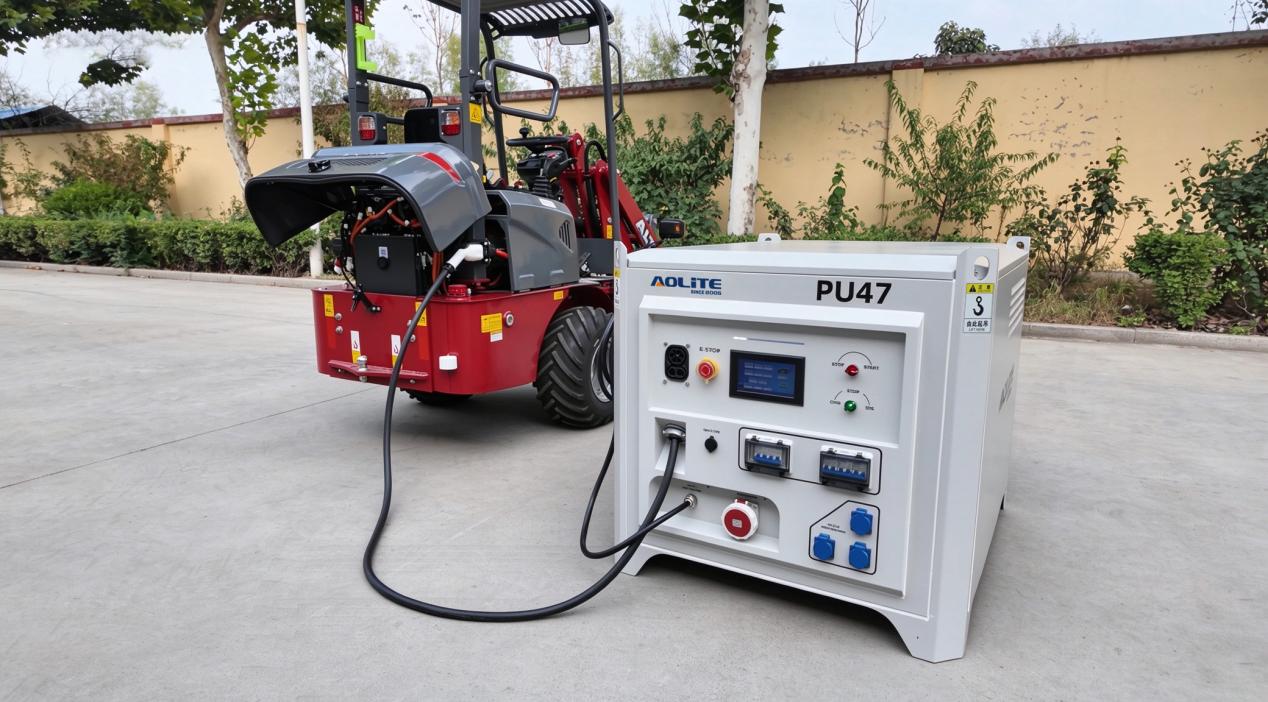
More Than an “Oversized Power Bank”: The PU47’s Robust Specifications
The AOLITE PU47 is positioned as a mobile battery energy storage system with integrated 40 kW DC fast-charging capability. It has a rated capacity of 47 kWh, a rated voltage of 460.8 V, uses lithium iron phosphate (LFP) batteries, and covers an operating temperature range of -20°C to 65°C.
Compared with similar products in the industry, the PU47’s differentiated advantages are immediately clear. Take the Volvo PU40 as an example: its total storage capacity is 40 kWh, its DC output power is 17 kW, and its protection rating is also IP54. The PU47 is about 17.5% higher in battery capacity and reaches 2.35 times the PU40’s DC output power. This means that in the same amount of time, the PU47 can deliver more energy to construction machinery, significantly shortening charging wait times.
In terms of interface compatibility, the PU47 comes standard with a Chinese GB/T 20234.3-2023 DC charging interface, supports a wide voltage range of 50 V to 1000 V, and can adapt to AOLITE compact electric construction machinery as well as pure electric passenger vehicles that comply with Chinese standards. With an optional CCS2 adapter gun, it can also meet the emergency charging needs of European electric passenger vehicles. The unit also comes standard with a European-standard DC charging inlet, allowing the PU47 itself to be recharged directly from European public charging stations, truly achieving two-way compatibility between Chinese and European charging standards.
One Machine, Multiple Functions: From DC Fast Charging to Job-Site Power Supply
The PU47’s design logic is clear and practical. When the grid is available, it charges its internal battery through the European-standard three-phase AC input cable on the left side (maximum 22 kW); when equipment needs power, it outputs DC fast charging of up to 40 kW through the DC charging gun. This “store–discharge” cycle essentially decouples the temporal and spatial dimensions of electricity—the machine does not have to be in a location with grid access at the exact moment it needs charging.
But the PU47’s value goes beyond charging. Its front panel is equipped with one European-standard 380 V three-phase industrial socket and three 220 V/16 A AC output sockets, with a total rated power of 22 kW, capable of powering lighting, power tools, measuring instruments and other AC loads on site. This dual-mode design of “DC charging + AC power supply” enables the PU47 to serve as a mobile energy hub at the job site—it can fast-charge an electric excavator while also powering angle grinders, lights and measuring equipment on site.
It is worth noting that the PU47’s AC output is a pure sine wave and can accommodate the vast majority of inductive loads, including motor-driven power tools. When the 220 V sockets are not in use, the European-standard three-phase socket can output the full 22 kW; when all 220 V sockets are in use, the three-phase power is automatically adjusted to 11 kW. The system intelligently distributes the load to prevent overload.
Safety and Intelligence: The Unseen Engineering Foundation
For an energy storage device weighing about 700 kg and containing high-voltage DC circuits of up to approximately 460.8 V and 380 V AC circuits, safety design is the underlying cornerstone of product capability.
The PU47 has a built-in BMS battery management system, with multiple protection functions including overcharge, over-discharge, over-temperature, short circuit and insulation detection. The AC input circuit has a built-in reverse-feed prevention interlocking protection relay—when the external grid is abnormal or loses power, the system automatically disconnects the input circuit without manual intervention, ensuring bidirectional safety for both the device and the grid. For scenarios requiring connection to the on-site grid, this design is particularly critical.
In terms of operation, the PU47 combines a 7-inch color touchscreen with physical knobs. The START/STOP knob controls startup and shutdown, while the CHG/DIS knob switches between AC charging and discharging modes. Together with indicator light status (CHG flashing means charging; DIS steadily lit means discharging), operation can be completed even while wearing protective gloves. The touchscreen displays SOC, voltage, current, power, temperature and fault information in real time. The fault log page can store the latest 50 fault records, making it easier to quickly identify problems.
Its IP54 protection rating enables it to adapt to conventional outdoor working environments. Within its operating temperature range of -20°C to 65°C, the PU47 can operate normally whether in the severe cold of northern mines or the intense heat of southern construction sites.
Scenarios Are Value: Where the PU47 Is Most Effective
The PU47’s target scenarios are highly focused: locations with weak or no grid coverage where electric construction machinery needs to operate continuously.
In remote mines and ports, if electric loaders and excavators need to return to fixed charging stations for recharging, the round trip consumes not only time but also equipment depreciation and labor costs. The PU47 can be moved and deployed as the working face advances, completing fast charging during gaps in operation. Based on data for similar products, a fully charged 47 kWh mobile power supply can provide 1–2 full fast charges for a small wheel loader, or 2–3 fast charges for a small excavator.
For scenarios with a grid but insufficient capacity, the PU47 offers another economical solution: charge itself at night using off-peak electricity prices through the 22 kW AC input, then use the 40 kW DC output during the day to fast-charge construction machinery. This avoids peak grid pressure and reduces electricity costs. With an optional solar panel input kit, off-grid photovoltaic energy storage charging can also be achieved, further reducing dependence on the grid.
In scenarios such as emergency rescue and disaster relief, and silent nighttime municipal operations, the PU47’s low-noise AC output capability also has practical value. In the European market, the PU47’s optional CCS2 interface support and standard European-standard input cable enable it to connect directly to Europe’s existing charging infrastructure, lowering the threshold for overseas deployment.
Maintenance Highlights and Whole-Lifecycle Considerations
Under normal use and maintenance conditions, the lithium iron phosphate battery can achieve a cycle life of more than 3,000 cycles (capacity retention ≥80%). To maximize battery life, it is recommended to perform a complete charge–discharge cycle every three months (20% → 100% → 20%) to calibrate SOC estimation accuracy. During long-term storage, SOC should be kept at 60%–80%, and the storage ambient temperature should be controlled between 0°C and 35°C.
Equipment transport must be carried out using a forklift or lifting gear with a rated load of no less than 1 ton, using the lifting holes at the four top corners or the forklift pockets at the bottom. Manual handling is strictly prohibited. Before transport, battery SOC should be adjusted to 30%–50%, in accordance with UN38.3 lithium battery transport regulations.
The PU47 was independently developed and designed by AOLITE. We have been deeply engaged in the small and medium-sized construction machinery field since 2005, and AOLITE completed sales of 1,000 electric loaders in the first three quarters of 2026. The launch of the PU47 marks AOLITE’s extension from a traditional construction machinery manufacturer toward “equipment + energy services.”
As the penetration rate of electric construction machinery continues to rise, mobile energy storage power supplies will no longer be optional accessories, but productivity tools as important as the equipment itself. The value logic of the PU47 is simple: the grid at a charging station is fixed, but the job site is mobile. Making power follow the machine is more economical and efficient than making the machine chase the grid.
Recommended News
Hot News
-
Trusted AOLITE in Europe
2024-05-08
-
INTERMAT 2024, International Construction Machinery and Building Materials Machinery Expo in Paris, France
2024-04-26
-
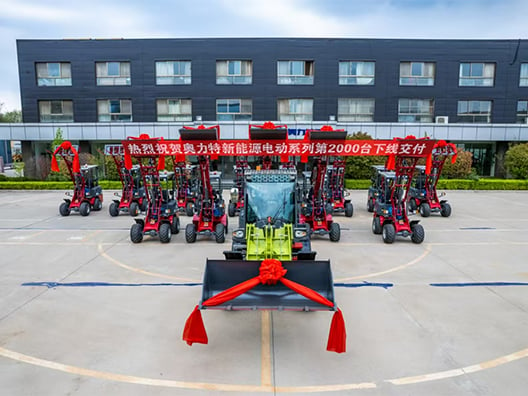
The 2000th unit of AOLITE New Energy Electric Loader rolled off the production line and delivered: Review, current situation and prospects
2024-04-25
-
AOLITE Electric Loader Milestone: The 2000 th off-line delivery
2024-04-25
-
AOLITE 2024 new arrival ETL600 eletric telescopic mini loader,new energy high efficiency four wheel drive telescopic loader
2024-02-19
-
AOLITE backhoe loaders official enter European markets with EU stage V engine
2024-06-27
 Consult